
Introduction: When the Collapse Was Already in Motion
On April 26, 2026, at M. A. Chidambaram Stadium, a packed Chepauk watched what looked like a routine T20 innings slowly unravel. Chennai Super Kings stumbled to 28/3 in the powerplay against Gujarat Titans, never recovering from the early damage. The headline number was not the final score of 158/7. It was the 66 dot balls scattered across 120 deliveries.
Thank you for reading this post, don't forget to subscribe!📌 QUICK ANSWER
Why do IPL teams collapse under pressure?
IPL teams collapse under pressure due to:
• Dot ball accumulation creating cognitive overload
• Crowd-induced stress at high-pressure venues
• Sunk cost fallacy driving risky shot selection
• Confirmation bias preventing tactical adaptation
• Neuroscience of choking disrupting automatic execution
This article explains each factor with IPL 2026 examples.
(Read our full IPL 2026 tactical evolution analysis for strategic context)

That is the real anatomy of an IPL teams collapse under pressure. Not chaos. Not bad luck. A slow, structured breakdown.
This pattern of IPL teams collapse is not unique to CSK. Across IPL 2026, we have seen Delhi Capitals, Mumbai Indians and Kolkata Knight Riders face similar breakdowns when pressure accumulates.
This is what makes IPL collapse analysis so revealing. When you zoom in, collapses follow repeatable patterns driven by cricket pressure psychology. The same triggers show up across seasons, teams, and venues. Dot ball pressure builds. Crowd noise amplifies stress. Tactical rigidity locks teams into failing plans. And eventually, execution breaks down.
This article breaks down five of those mechanisms that explain why teams choke in IPL situations:
- Dot Ball Death Spiral
- Crowd Pressure at high-intensity venues
- Sunk Cost Fallacy in death overs
- Confirmation Bias in decision-making
- The neuroscience of choking vs clutch performance
Because in pressure in T20 cricket, failure is rarely random. It is predictable.
The Dot Ball Death Spiral: How Pressure Compounds Ball by Ball

When the Scoreboard Becomes a Threat
When IPL teams collapse, dot balls are almost always the trigger. They are not just empty deliveries they are psychological accelerants.
In dot ball pressure cricket, every consecutive non-scoring ball increases cognitive load. A batter is already processing line, length, field placement, required rate, and match situation. Add four or five dots, and the brain shifts from decision-making to survival.
At Chepauk, CSK’s 28/3 powerplay was not just a poor start. It was the beginning of a cognitive spiral. By the 10th over, they had already faced 38 dot balls. That volume changes how decisions are made.
This is where many ask: why do IPL teams collapse suddenly?
The answer is they don’t. The collapse begins quietly with pressure accumulation.
From Control to Compulsion
Under normal conditions, T20 batting is selective aggression. Players target specific bowlers and matchups.
Under pressure, that changes.
- Singles feel insufficient
- Batters premeditate shots
- Risk tolerance spikes irrationally
This is the effect of dot balls in T20 cricket. It pushes players toward immediate relief rather than optimal decisions.
A batter stops asking, “Is this the right ball?”
They start thinking, “I have to score now.”
That shift is where wickets come from.
When Pressure Spreads Across the Lineup
Dot ball pressure is contagious. Once a few batters struggle, incoming players inherit the urgency.
A similar pattern appeared in IPL 2026 when Delhi collapsed for 75 against RCB, with long stretches of dots dictating the innings. The problem wasn’t just execution. It was belief erosion.
Teams that manage pressure in T20 cricket better treat dot balls as information, not failure. They reset after each delivery instead of reacting emotionally.
Understanding cricket fielding positions helps explain how dot ball pressure is created tactically.
💡Micro Insight
Dot balls don’t just slow scoring. They reduce decision quality. And once that drops, wickets follow.
Crowd Psychology at Chinnaswamy: When Noise Becomes Pressure

The Stadium as a Psychological Factor
At M. Chinnaswamy Stadium, the game is never just bat versus ball. It is environment versus composure.
This ground is known for high scoring. But behind that lies a deeper factor: how crowd pressure affects cricketers.
With over 30,000 fans, constant noise, and rapid scoring, the margin for error shrinks mentally before it does physically.
Understanding why IPL teams collapse at high-pressure venues like Chinnaswamy is critical. The psychological load is measurably different than neutral venues.
Why Visiting Teams Struggle
Crowd noise affects performance in three key ways:
- Attention disruption: Players lose focus under constant sensory input
- Communication breakdown: Calling between wickets becomes harder
- Time pressure amplification: Every ball feels more urgent
This directly impacts decision making under pressure in sports.
At Chinnaswamy, even a small hesitation becomes costly. A delayed reaction to a 140 km/h delivery is the difference between control and dismissal.
Real Match Breakdown
The abstract idea of crowd pressure becomes clearer when you look at Chinnaswamy’s most extreme moments.
- In the 2023 RCB vs LSG thriller, the crowd’s hostility reached a point where Gautam Gambhir turned to the stands and “shushed” 30,000 fans after the final ball. That reaction alone showed how deeply the noise had penetrated the contest. In the same game, Avesh Khan’s helmet-throw celebration wasn’t just adrenaline—it was release from sustained psychological pressure.
- No player has weaponized this better than Virat Kohli. When his bowlers are under pressure, he turns up the crowd lifting energy and intensity instantly. That support sharpens execution, and wickets often follow. He’s not just reacting to the atmosphere. He’s controlling it.
- The most extreme case dates back to 2013, when Chris Gayle scored 175*. As sixes rained into the stands, the crowd turned every delivery into a spectacle. Pune’s bowlers visibly lost discipline, conceding 263 runs, not purely because of skill mismatch, but because the environment became overwhelming.
- Even elite players feel it. In 2019, with MS Dhoni chasing off the last ball, the stadium dropped into near silence before exploding after the run-out. Players later admitted they couldn’t hear calls for several seconds.
These are not isolated moments. They show how crowd noise shifts players from controlled execution to emotional reaction.
Home Advantage Is Psychological Safety
Home teams like Royal Challengers Bengaluru benefit from familiarity. Not just with the pitch, but with the noise.
They interpret crowd energy as support. Visiting teams interpret it as threat.
That difference creates two states:
- Home players operate with controlled aggression
- Away players rush decisions
In a 220-run game at this venue, chasing teams often panic early, treating singles as failure. That is where pressure in T20 cricket becomes overwhelming.
💡Micro Insight
At Chinnaswamy, the crowd does not just create noise. It changes how quickly and how well players think.
The Sunk Cost Fallacy in Death Overs: When Teams Chase Redemption
The Trap of “Making Up for It”
The sunk cost fallacy explains many mental mistakes in IPL matches.
Once a team starts slowly, the innings becomes about recovery. But instead of recalibrating, players try to compensate.
In the CSK vs GT game, the final overs saw aggressive hitting. But it came too late and at too much risk.
This is a core reason why IPL teams collapse in death overs. Players are not playing the present situation they are trying to compensate for the past.
Batting Under Psychological Debt
After a slow start:
- Players feel they “owe” runs
- Risk-taking increases sharply
- Shot selection becomes forced
Instead of building a total, they try to erase earlier mistakes.
That leads to collapses late in innings.
A similar pattern was seen in IPL 2025 when RCB lost 7 wickets for minimal runs during a chase after being in control. The collapse was not technical. It was psychological escalation.
Captaincy and Decision Errors
The same bias affects captains.
- Persisting with an expensive bowler
- Sticking to pre-planned roles
- Ignoring match conditions
😮Example – Hardik Pandya sticking to bowl first after winning the toss irrespective of the Pitch conditions and Situtaion (20 out of 22 times since 2024)
Real Match Breakdown
This bias is not theoretical, it has defined captaincy patterns in recent IPL seasons.
- Hardik Pandya’s repeated decision to bowl first since 2024 is a clear example of anchoring to a “successful formula.” Even on slow, abrasive pitches in Delhi and Lucknow, where batting first is advantageous, the decision remained unchanged. The consequence was predictable: by the time Mumbai Indians batted, the pitch had slowed, and middle-order batters were forced into high-risk recovery.
- The same “psychological debt” is visible at the player level. In IPL 2026, Riyan Parag, struggling for form, consumed 12 balls for 6 runs against LSG. Attempting to compensate, he played a forced reverse sweep against spin and was dismissed—triggering a near-collapse in a modest chase.
- A similar pattern appeared with Ruturaj Gaikwad. After consecutive dot balls against Rajasthan, he charged a 150 kph delivery from Nandre Burger—an irrational escalation driven by urgency, not conditions.
- Even bowling strategies reflect this bias. Mumbai Indians repeatedly held Jasprit Bumrah back for death overs while conceding heavily in the middle phase. By the time their best bowler entered, the game state was already lost.
These are not tactical errors. They are attempts to “recover” past decisions instead of optimizing the present.
This is how captains make wrong decisions in IPL games.
In contrast, GT’s approach in the Chepauk match showed flexibility. Bowlers were rotated based on conditions, not reputation.
That is the difference between reacting and adapting.
💡Micro Insight
The biggest mistake is not a bad over. It is refusing to change after it.
Confirmation Bias in Tactical Decisions: Seeing What You Expect
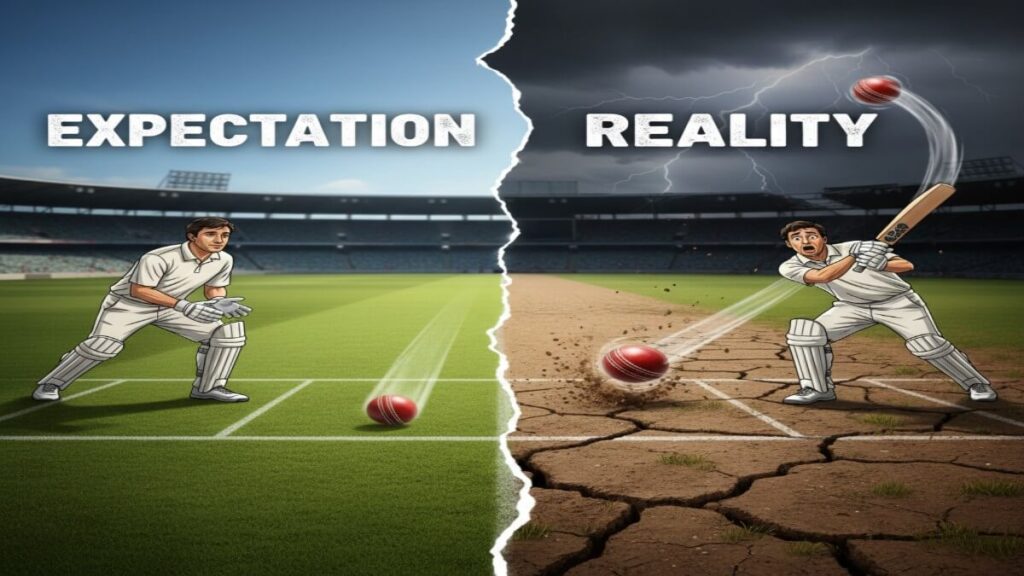
The Illusion of Experience
Confirmation bias is one of the most overlooked aspects of sports psychology in cricket.
Teams often enter matches with fixed ideas:
- This pitch will behave a certain way
- This player always performs here
- This strategy works at this venue
When reality differs, they are slow to adjust.
When Plans Override Evidence
At Chepauk, CSK expected a familiar surface. Instead, the pitch offered bounce and seam early.
By the time they adapted, the innings was already damaged.
This is a classic IPL collapse analysis pattern. Teams fail not because they lack skill, but because they misread evolving conditions.
Real Match Breakdown
- A clear 2026 example comes from Lucknow Super Giants.
In their loss to KKR, LSG had data showing Rinku Singh struggles against high-pace short deliveries. Instead of adapting, they stuck to a pre-planned wide-yorker strategy.
Rinku anticipated the line and cleared the boundary twice. The failure wasn’t execution, it was refusing to update the plan based on real-time evidence.
- In contrast, Punjab Kings have built their season around adaptability. Their 2025 Dharamshala game against LSG became a turning point. Using ball-tracking data, they identified abnormal swing conditions and replaced spin with seam at the last moment. The result was a 24/4 powerplay collapse—now a reference point for data-driven decision making.
As of IPL 2026, this gap is visible in standings. Teams like PBKS and RCB adjust dynamically. Teams like CSK and MI often rely on legacy patterns.
The lesson is simple: in T20 cricket, pre-match plans expire quickly.
Data vs Instinct
Modern teams rely increasingly on data:
- Matchup analysis
- Real-time adjustments
- Flexible tactics
Teams that ignore data often fall into rigid patterns.
That is why cricket mental toughness is not just about execution. It is about adaptability.
This cognitive rigidity is one of the hidden reasons IPL teams collapse even with experienced players. Mental inflexibility is as dangerous as technical failure.
💡Micro Insight
The most dangerous assumption in T20 cricket is believing the game will follow the script.
Choking vs Clutch: The Neuroscience of Pressure Performance
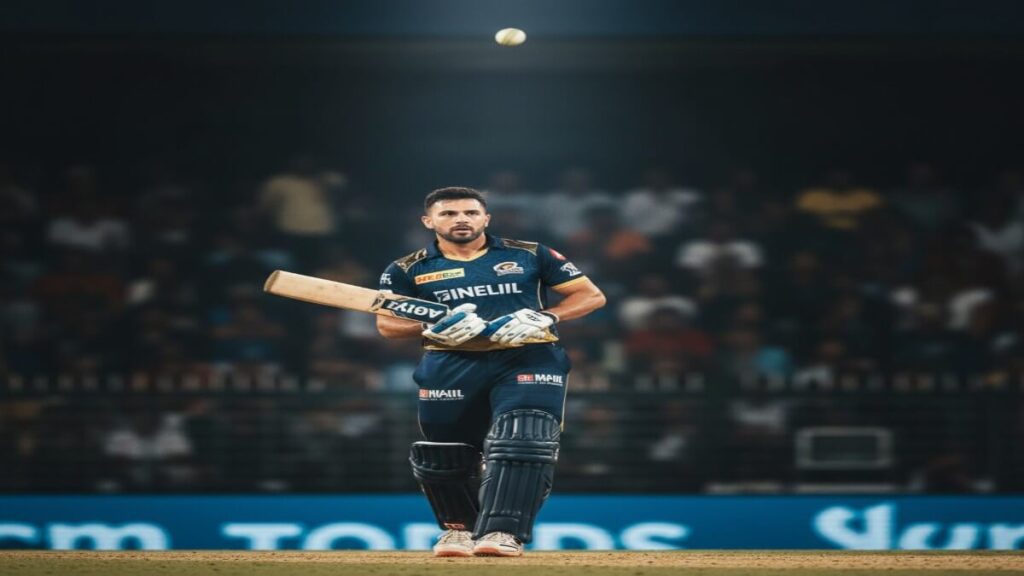
What Happens Inside the Brain
Choking is not about fear. It is about control.
Under pressure, the brain shifts from automatic execution to conscious control. This disrupts timing and coordination.
This explains why teams choke in IPL matches even with experienced players.
The Role of the Amygdala
When pressure rises:
- The amygdala detects threat
- Stress hormones increase
- Decision-making slows
Players begin overthinking skills that are normally automatic.
This is why even simple shots go wrong under pressure.
Why Some Players Thrive
Players like MS Dhoni and Virat Kohli show the opposite pattern.
- They simplify decisions
- They focus on the next ball
- They maintain execution under stress
That is clutch performance.
Real Match Breakdown
The difference between choking and clutch performance becomes clear when comparing real scenarios.
- Virat Kohli’s chase against SRH in March 2026 is a textbook example. Chasing 202, he stayed unbeaten on 69 (38), accelerating without panic and finishing the game in 15.4 overs. His approach remained unchanged regardless of required rate.
- Similarly, MS Dhoni’s finishing record is built on manipulating pressure. In the 2010 Dharamshala match, he chased 16 off the final over with calculated aggression, targeting the bowler rather than reacting to the situation.
Contrast this with failures under pressure.
- In 2023, KL Rahul scored 68 off 61 balls chasing 135 against Gujarat Titans. Despite staying till the end, the accumulation of dot balls made the target unreachable—a classic case of over-control turning into paralysis.
- In IPL 2026, Hardik Pandya attempted an ultra-aggressive approach in a shortened chase against Rajasthan, swinging at nearly every ball and collapsing early. The team never recovered.
These contrasts highlight a key truth: clutch players simplify decisions, while choking players amplify them.
Training the Mind
Modern teams are investing in:
- Pressure simulation training
- Breathing techniques
- Visualization routines
These improve performance under pressure by stabilizing attention and reducing stress impact.
💡Micro Insight
Clutch performance is not talent. It is trained composure under stress.
Conclusion: Collapses Are Patterns, Not Accidents
The CSK collapse in IPL 2026 was not an isolated event. It was a textbook example of an IPL team collapse under pressure.
The question “why do IPL teams collapse under pressure?” has a clear answer: predictable psychological patterns that can be identified, measured, and managed.
Across matches and seasons, the same patterns repeat:
- Dot balls build pressure
- Crowds amplify stress
- Poor decisions escalate risk
- Bias blocks adaptation
- The brain loses control under pressure
Understanding cricket pressure psychology turns these patterns into opportunities.
Teams that combine data, tactical flexibility, and mental conditioning gain a real advantage. Because in T20 cricket, skill alone is not enough.
The difference between winning and collapsing often comes down to one moment. One decision. One response under pressure.
And the teams that handle that moment better are the ones that win consistently.
For more IPL tactical insights, explore our complete IPL 2026 analysis.
Want More Tactical Analysis Like This?
This is the kind of deep-dive you won’t find on Cricbuzz, ESPN or on any other platforms
Here’s how to stay updated
📧 Get weekly insights: Subscribe to our newsletter – Free IPL tactics cheatsheet inside
📱 Daily breakdowns: Follow @the_deepmidwicket on Instagram
🏏 Explore more: Browse all IPL 2026 analysis