

IPL 2026 has broken almost every assumption you built watching the last few seasons. If you’re still reading games the old way, you’re missing what’s actually going on.
Thank you for reading this post, don't forget to subscribe!Yes, runs are flowing. Yes, targets are getting chased down like they mean nothing. But here’s the thing. The teams winning consistently aren’t always the ones scoring the most. They’re the ones figuring the game out faster.
This season is layered. I’ve watched every IPL 2026 match so far. Not just watched—analyzed. Rewound. Took notes. And what I’m seeing isn’t being discussed enough in mainstream coverage. The real tactical story is hiding in plain sight. Between the impact player rule evolving, smarter powerplays, venue-specific tactics, and brutal death overs, this is easily the most tactically complex IPL we’ve seen.
Let’s break it down properly.
1. The Impact Player Revolution 🎯
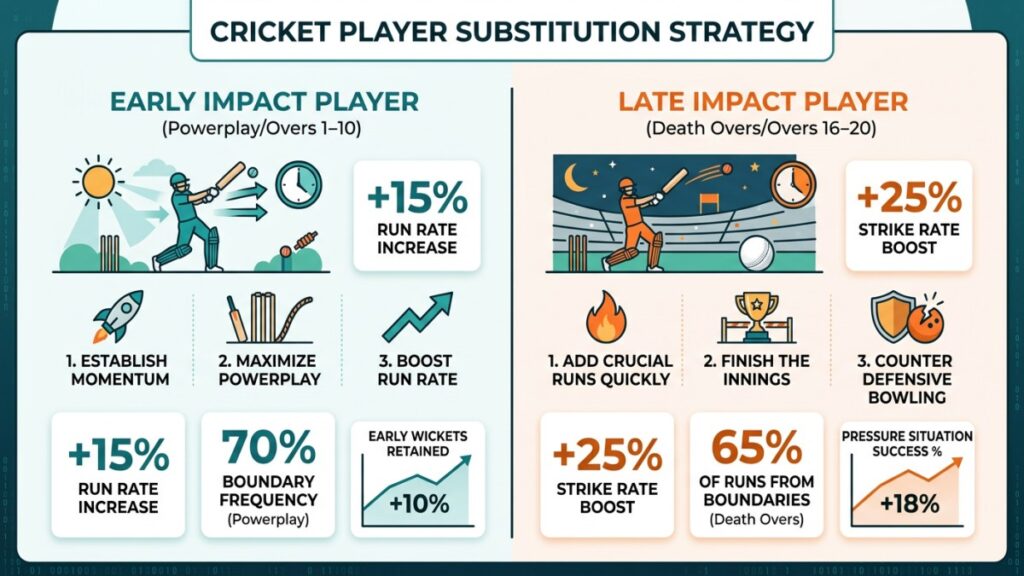
The rule is simple. The decisions aren’t.
Every team has an impact player. But not every team understands how to use it properly. That gap is quietly deciding the table.
Teams name five potential substitutes before the game and can bring one in during natural breaks. The rule has been around since 2023, but IPL 2026 has taken its usage to another level.
This isn’t a backup anymore. It’s a tactical lever.
Two clear philosophies
Teams are broadly doing one of two things:
- Bringing in a batter if things go wrong early
- Bringing in a bowler to exploit pitch or matchups
💡Key insight:
- Extra bowler usage → 54.3% win rate
- Extra batter usage → 45.7% win rate
So while the narrative leans toward batting depth, bowling-based impact decisions are actually more efficient.
Timing is everything
Another big shift is when teams are using the impact player:
- Used in first 10 overs → 58% win rate
- Used late → less influence on outcome
Two matches sum this up perfectly:
- In a game involving Delhi Capitals, Sameer Rizvi walked in at 21/2 and played a composed 70 off 47*, finishing the chase with 17 balls to spare. That’s a planned stabiliser move.
- In a match featuring Chennai Super Kings, an early panic substitution at 26/3 disrupted team balance and backfired.
Same tool. Completely different thinking. And this is what separates table-toppers from mid-table teams; tactical preparation, not just squad depth.
(Learn more about cricket fielding positions that matter in powerplay traps)
What smart captains are asking
The best teams are thinking ahead, not reacting:
- If this is a 175 pitch, do I need another wicket-taker?
- If their top order is right-hand heavy, can I introduce a different angle?
- Which overs can I not afford to lose?
Key takeaway:
The impact player isn’t a 12th man. It’s a pre-planned tactical move. Teams that react late are losing.
2. Powerplay Strategies Have Shifted ⚡️
It’s not just about going hard anymore
Yes, aggressive starts are everywhere. Players like Vaibhav Sooryavanshi, Abhishek Sharma and Priyansh Arya are coming out swinging. At the same time, experienced players like Virat Kohli, KL Rahul and Sanju Samson are mixing aggression with control.
But the real shift is happening with the ball.
Bowling teams are no longer trying to “get through” the powerplay. They’re trying to win it.
Field placements are now tactical questions
With only two fielders outside the circle, captains are getting creative:
- Deep square + fine leg → force square hits instead of straight
- Deep third man → shut down ramps and edges
- Leg-side traps → target pull shots off hard lengths
I noticed something in Match 23 that commentators completely missed: Rabada’s field had THREE variations depending on the batter’s stance. That’s not random. That’s homework.
GT vs CSK: a perfect example
In a match between Gujarat Titans and Chennai Super Kings:
- Kagiso Rabada took 3/25 in the powerplay
- CSK collapsed early
- GT chased comfortably after going 55/0 in the powerplay
At the 6-over mark:
- CSK: 28/3
- GT: 55/0
That gap basically ended the contest.
The risk-reward equation
- 60+ runs with ≤1 wicket → win probability jumps ~22%
- 3 wickets down early → massive pressure despite batting depth
Key takeaway:
Powerplay is now about controlling risk, not just maximizing runs.
3. The Venue Factor – Ekana Case Study 🔥
Ekana isn’t low-scoring. It’s demanding.
Lucknow’s Ekana Stadium is one of the most misunderstood venues.
It’s not just slow. It’s a proper test of discipline and decision-making.
What the pitch does
- Slow black-soil surface
- Ball grips slightly
- Timing becomes inconsistent
So even good shots don’t always go for boundaries.
Why it feels tough
Batters struggle because:
- Clean hitting is harder
- Acceleration shots need perfect contact
- Dot balls build pressure quickly
This turns the middle overs into a battle.
Middle overs decide everything
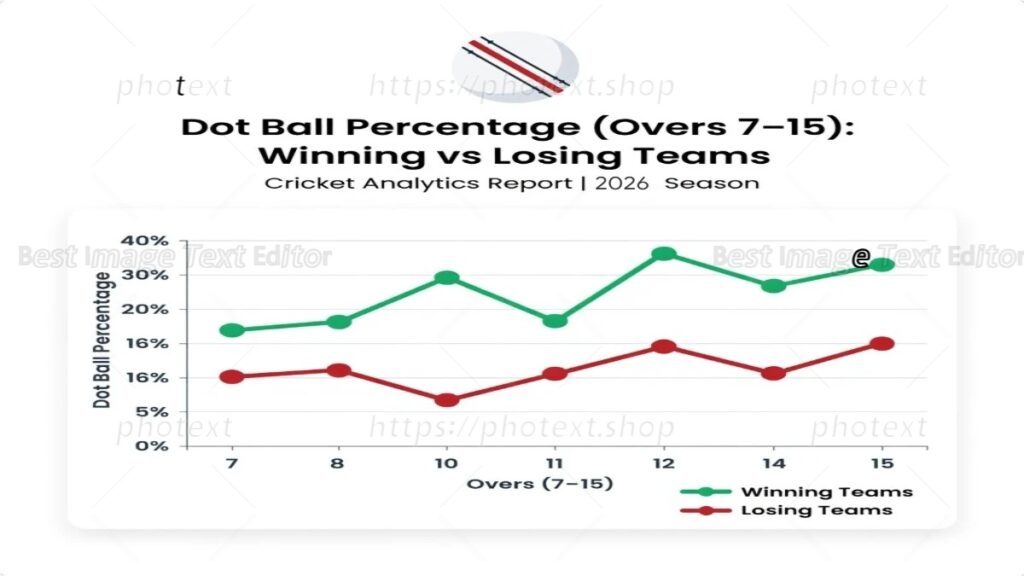
Overs 7–15 are where games slow down:
- Spinners control tempo
- Batters get stuck in dot-ball sequences
- Required rate climbs quickly
Venue numbers (April 2026)
- Batting second wins: 13
- Batting first wins: 9
- Chasing success: 56.5%
Captains prefer chasing and backing their bowlers to control totals.
Weather and pitch conditions affect outcomes. (Understand how DLS methodadjusts for such factors)
DC vs LSG: the template match
In a game involving Delhi Capitals and Lucknow Super Giants:
- LSG: 141 all out
- DC: 145/4 in 17.1 overs
- Rizvi: 70* anchoring the chase
No big hitting. Just smart cricket.
Why overseas players struggle here
Batters used to faster pitches often:
- Commit too early
- Try forcing shots
- Misread pace
At Ekana, you have to:
- Play later
- Hit straighter
- Value singles
Key takeaway:
You don’t win here with one big over. You win by avoiding pressure spikes.
4. Death Bowling & Late-Game Tactics 🎯
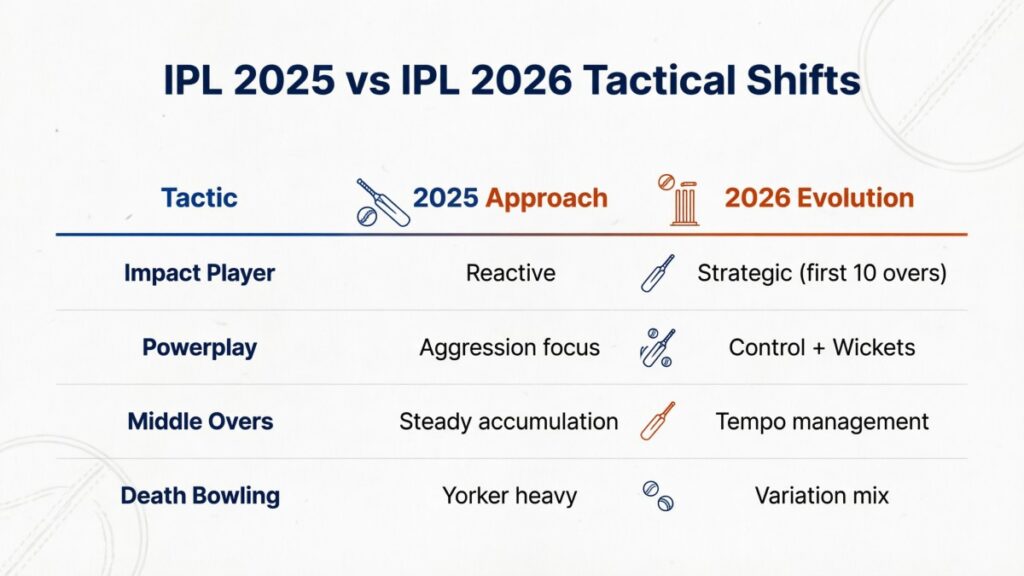
Death overs are now unpredictable
The old idea of “just bowl yorkers” doesn’t work anymore.
Batters expect it. They’re ready.
So bowlers are mixing:
- Wide yorkers
- Slower balls
- Angle variations
Execution has to be perfect.
Fielding is hyper-specific now
Teams are building fields to deny specific shots:
Wide yorker setup:
- Third man
- Deep point
- Long-off
- Allow single to long-on
Pace-off setup:
- Deep midwicket
- Long-on and long-off
- Deep square
The goal is simple: allow singles, deny boundaries.
Sai Sudharsan’s 87: a lesson in failure
In a match involving Sai Sudharsan:
- Scored 87 off 46
- GT chased 158 easily
Three clear mistakes from the bowling side:
- Too many balls in the slot
- No consistent wide yorker plan
- Easy strike rotation
Also important: CSK played 66 dot balls, including 38 in the first 10 overs. That meant the chase never felt pressured.
Why death bowling is harder now
- Batting depth is stronger
- Fresh hitters keep coming
- One bad ball changes the over
💡Key takeaway:
Death bowling is now about variation, precision, and planning together.
5. The Middle Overs Revolution
This is where matches are actually decided
Everyone talks about powerplays and death overs. But IPL 2026 is increasingly about tempo.
The best teams are not just scoring faster. They’re losing fewer balls.
What “losing fewer balls” means
- Fewer dot balls
- Fewer forced shots
- Fewer panic swings
Dot-ball pressure is the real killer.
That Chepauk innings with 66 dot balls is the perfect example of how an innings collapses tactically.
Strike rotation is back
Especially on slower surfaces like Ekana:
- Singles matter more
- Boundaries are harder
- Pressure builds quickly
That’s why controlled chases are working better.
Spin is controlling the game
Spinners are no longer just wicket-takers. They are:
- Managing tempo
- Forcing low-risk play
- Breaking rhythm
💡Key takeaway:
Teams winning IPL 2026 are managing the middle overs better than anyone else.
6. What This Means Going Forward
The table reflects tactical clarity
Punjab Kings are leading with 13 points from 7 games, combining strong bowling with aggressive batting.
Close behind:
- Royal Challengers Bengaluru
- Sunrisers Hyderabad
- Rajasthan Royals
RCB’s position is backed by form from Virat Kohli and solid middle-order performances.
Teams chasing qualification
- Kolkata Knight Riders
- Mumbai Indians
- Lucknow Super Giants
These teams need near-perfect runs now.
What a title-winning team will need
- A clear impact player strategy
- Strong middle-over control
- Multiple death bowling options
Key takeaway:
IPL 2026 is rewarding decision making clarity more than raw talent.
What I’m Watching in the Playoffs
Based on these tactical trends, here’s what will decide the trophy:
- Impact player discipline – Teams that plan it, not react with it
- Spin control in middle overs – Dot balls kill chases
- Death bowling depth – You need 3+ reliable options
- Venue adaptability – One-size-fits-all won’t work
My playoff predictions:
- Punjab Kings and Royal Challengers Bengaluru have the tactical clarity
- Sunrisers Hyderabad has the firepower but needs better death bowling
- RR & GT are re-calibrating on their winning formula
- Whoever figures out the impact player best will lift the trophy
This isn’t guesswork. It’s pattern recognition.
Final Thoughts
This season feels different because it is different.
Not because of bigger hits or bigger names, but because the tactical level has gone up.
The four defining shifts:
- Impact player is now a strategic weapon
- Powerplay is about control, not chaos
- Venues like Ekana reward discipline
- Death bowling demands variation and precision
This is basically a tactical lab. Every match adds something new.
For team-specific tactical breakdowns, check our IPL 2026 team previews
Want More Tactical Analysis Like This?
This is the kind of deep-dive you won’t find on Cricbuzz or ESPN.
Here’s how to stay updated:
📧 Get weekly insights: Subscribe to our newsletter – Free IPL tactics cheatsheet inside
📱 Daily breakdowns: Follow @the_deepmidwicket01 on Instagram
🏏 Explore more: Browse all IPL 2026 analysis
Your turn: Which tactical shift surprised you most? Drop a comment below 👇