
A captain just won the toss. He’s chosen to bowl. Now comes one of the most tactical parts of cricket — setting the field.
Thank you for reading this post, don't forget to subscribe!But if you’ve ever looked at a cricket field and felt overwhelmed by all the position names — slip, gully, cow corner, silly point — you’re not alone.
In this complete guide, we break down every single cricket field position in simple language. Where each fielder stands, what they do, and when captains use them.
Let’s walk through the field, one position at a time.
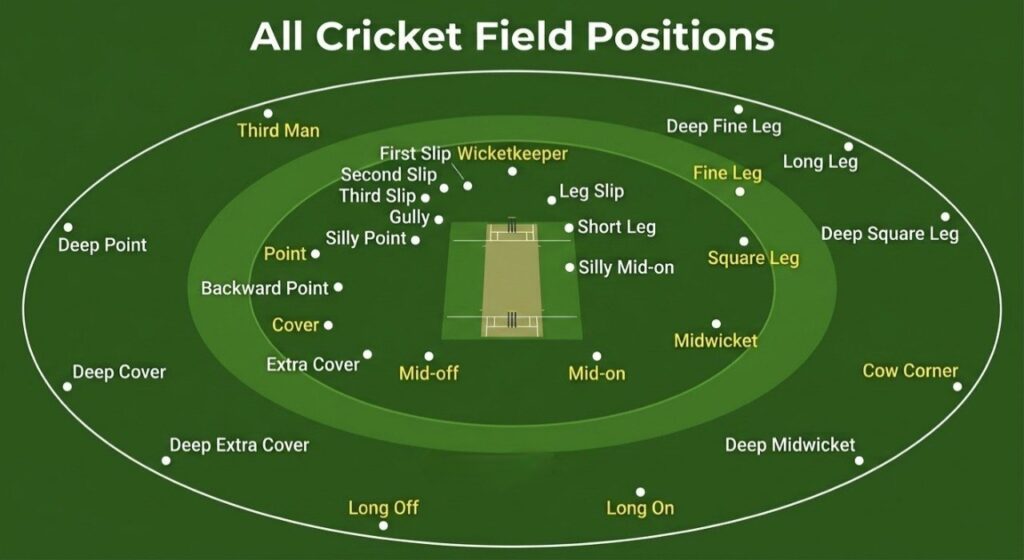
Understanding the Cricket Field Layout
Before diving into individual cricket field positions, let’s understand the basics of how the field is divided.
Two Halves: Off Side and Leg Side
Imagine a line running straight down the pitch from one set of stumps to the other. This divides the field into two halves:
| Half | Also Called | Location |
|---|---|---|
| Off Side | Off side | The side the batter’s bat faces when in stance |
| Leg Side | On side | The side behind the batter’s legs |
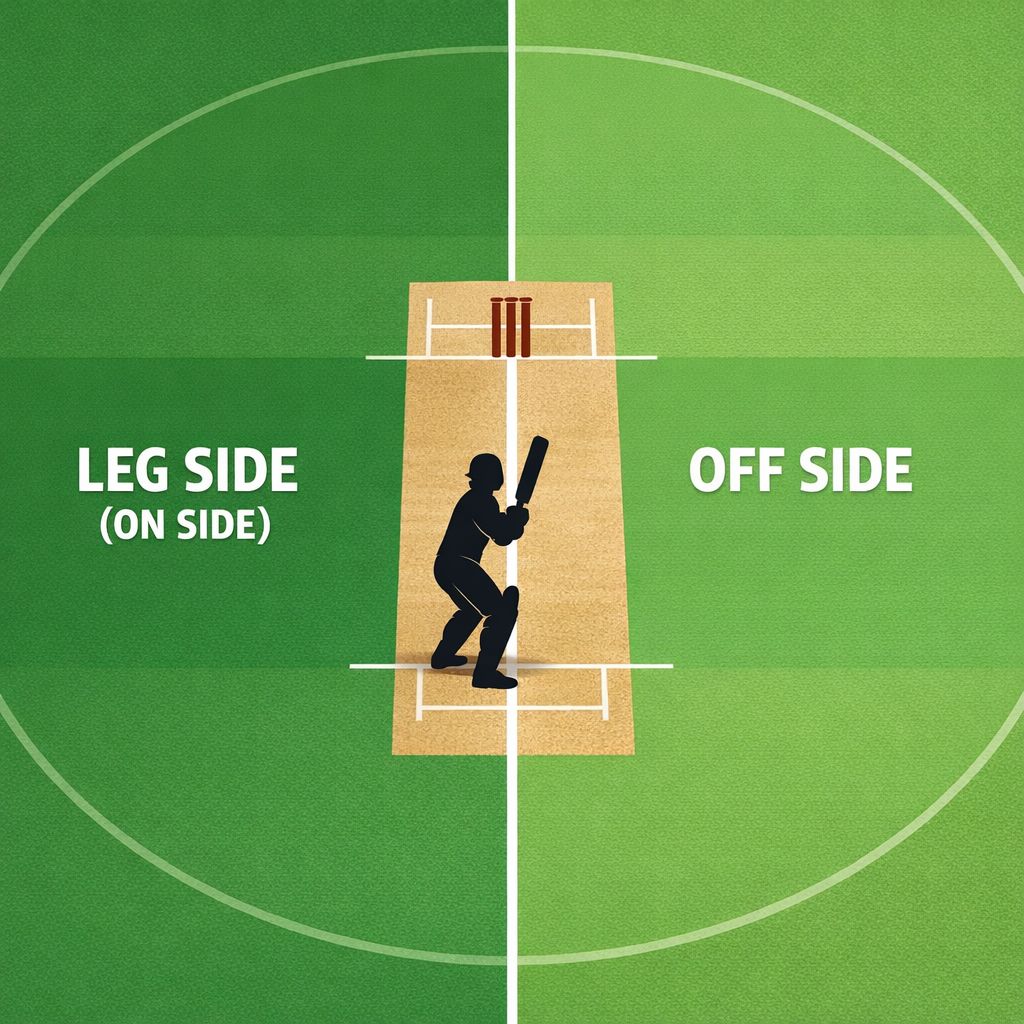
“For a right-handed batter, off side is to the batter’s right. For a left-hander, it flips.”
Three Depth Zones
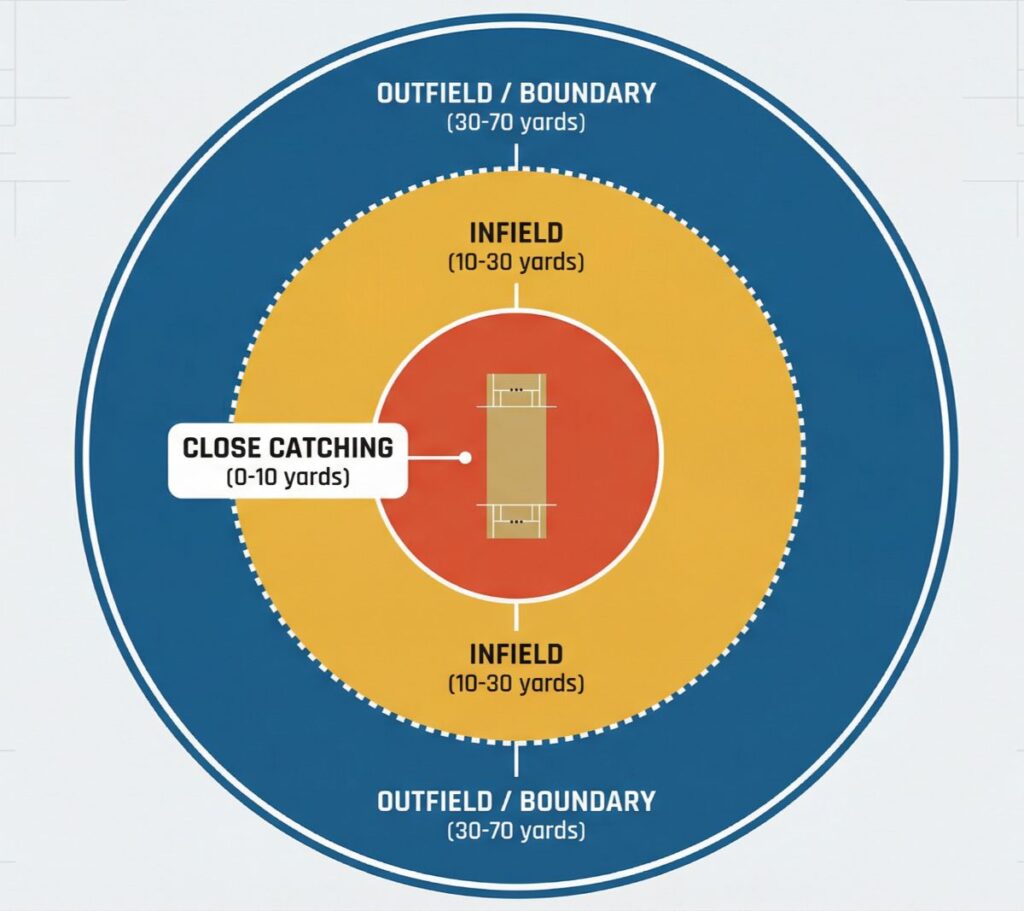
Every cricket field position falls into one of three depth zones:
| Zone | Distance from Batter | Purpose |
|---|---|---|
| Close Catching | 0–10 yards | Catch edges and deflections |
| Infield (Inner Ring) | 10–30 yards | Stop singles, take sharp catches |
| Outfield (Boundary) | 30–70 yards | Prevent boundaries, take high catches |
In Front of & Behind the Wicket
- In front of the wicket = towards the bowler’s end
- Behind the wicket = towards the wicketkeeper’s end
- Square of the wicket = directly to the side (90°)
Now let’s go through every cricket field position, zone by zone.
Zone 1: Close Catching Positions
These fielders stand within a few yards of the batter. Their job is to catch edges, deflections, and bat-pad chances. Primarily used in Test cricket.
Off Side Close Catchers
| Position | Where | Role |
|---|---|---|
| Wicketkeeper | Directly behind the stumps | Catches edges, manages stumpings, collects deliveries |
| First Slip | Right next to the keeper (off side) | Catches outside edges off fast bowlers |
| Second Slip | Next to first slip (wider) | Covers wider edges, especially off fuller deliveries |
| Third Slip | Next to second slip (wider still) | Used when the ball is moving a lot (swing/seam) |
| Fourth Slip | Next to third slip | Rare — used on extremely seam-friendly pitches |
| Fly Slip | Behind the slip cordon, slightly deeper | Catches edges that fly over the regular slips |
| Gully | Square on the off side, close in | Catches cut shots that take the edge or are hit in the air |
| Silly Point | Very close to batter, off side, in front of wicket | Catches bat-pad deflections off spinners |
| Silly Mid-off | Very close, straight-ish off side | Similar to silly point, slightly straighter |
Leg Side Close Catchers
| Position | Where | Role |
|---|---|---|
| Leg Slip | Next to the keeper, on the leg side | Catches leg-side edges, especially off seamers angling in |
| Short Leg | Very close to batter, leg side, in front of square | Catches bat-pad chances off spinners. One of the most dangerous positions — fielders wear helmets and shin guards |
| Leg Gully | Square on the leg side, close in | Catches deflections off the gloves/body on the leg side |
| Silly Mid-on | Very close, straight-ish leg side | Catches bat-pad chances on the leg side off spinners |
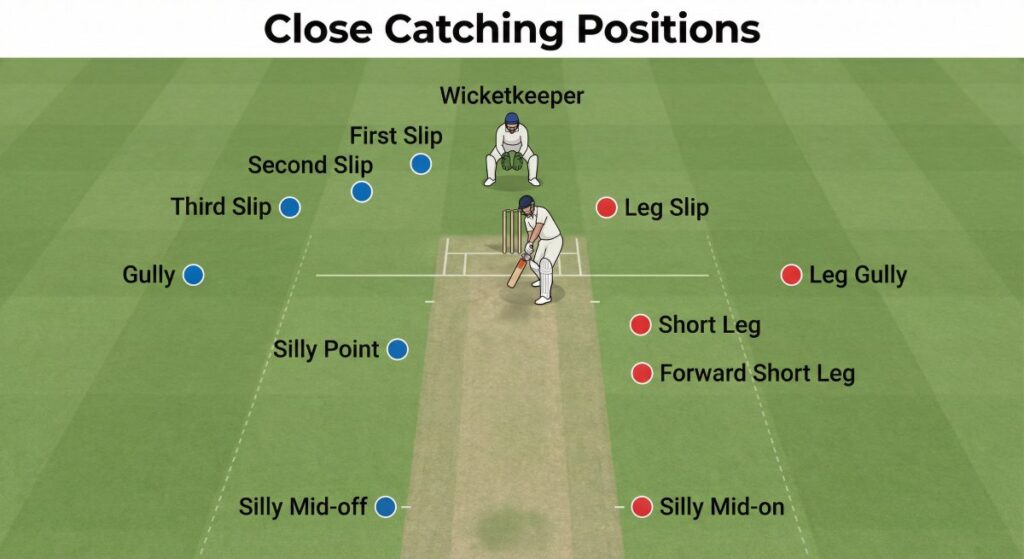
⚠️ Close catching positions are mostly used in Test cricket where patience, edges, and bat-pad catches are common. You’ll rarely see a silly point or leg slip in a T20 match.
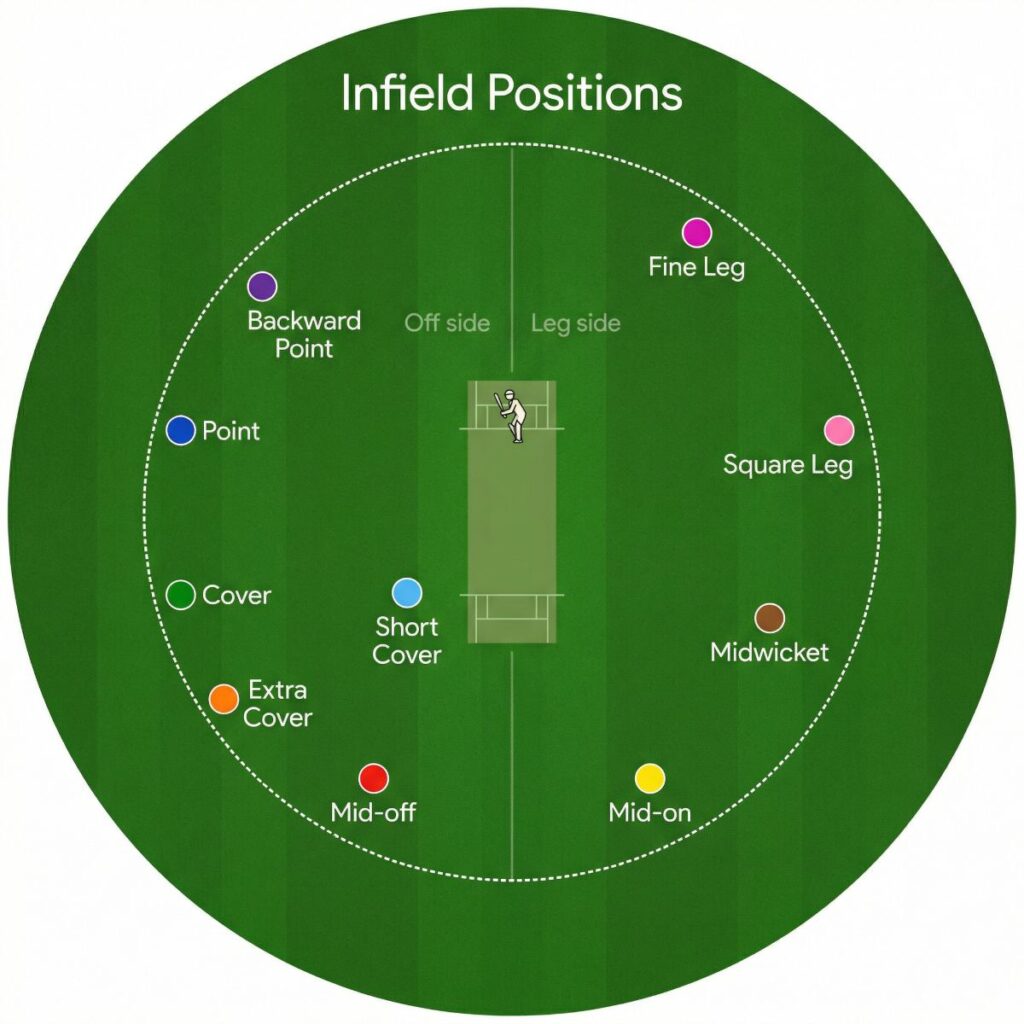
Zone 2: Infield Positions (Inside the 30-Yard Circle)
These fielders patrol the inner ring. Their main job is to stop quick singles and twos and occasionally take sharp catches.
Off Side Infield
| Position | Where | Role |
|---|---|---|
| Point | Square on the off side, ~25 yards from batter | Stops cut shots and square drives. A key position in all formats |
| Backward Point | Slightly behind square on the off side | Covers the area between point and gully, stops late cuts |
| Cover | Between point and mid-off, ~30 yards | One of the most important fielding positions in cricket. Stops cover drives |
| Extra Cover | Between cover and mid-off | Stops drives played straighter than cover but wider than mid-off |
| Mid-off | Straight-ish on the off side, near the bowler | Stops straight drives on the off side. Captain or bowler often fields here to stay involved |
| Short Cover | Closer version of cover, ~15 yards | Used against spinners to cut off the drive early |
Leg Side Infield
| Position | Where | Role |
|---|---|---|
| Mid-on | Straight-ish on the leg side, near the bowler | Stops straight drives on the leg side. Mirror of mid-off |
| Midwicket | ~45° on the leg side, inside the circle | Stops flicks, pulls, and clips into the leg side. One of the busiest positions |
| Square Leg | Directly square on the leg side, ~25 yards | Stops pulls and sweeps. Also where the square leg umpire stands |
| Forward Short Leg | Closer than short leg, slightly in front | Even more attacking than short leg — used for bat-pad catches off spinners |
| Fine Leg | Behind square on the leg side, inside circle | Stops glances, flicks, and deflections behind square |
Zone 3: Outfield / Boundary Positions
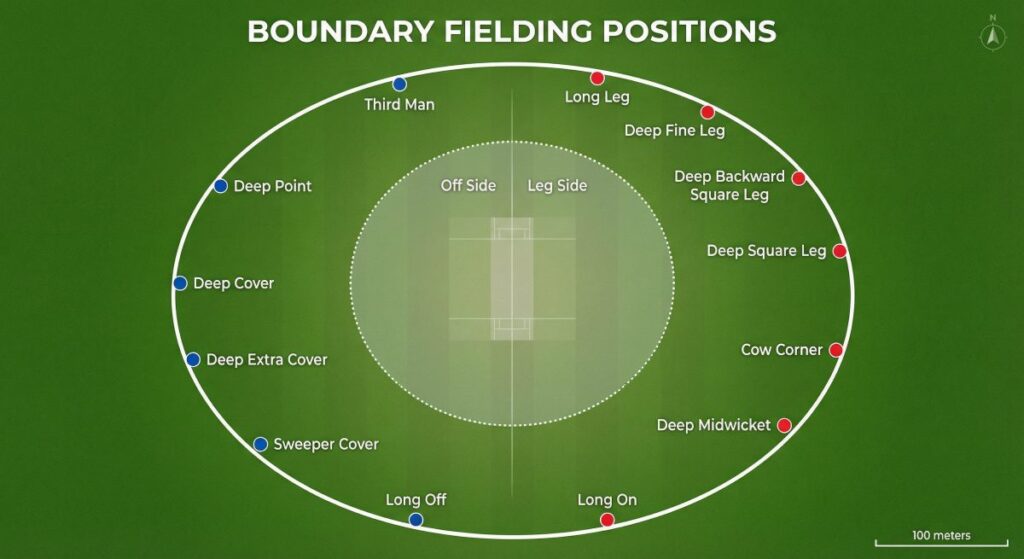
These fielders stand near the boundary rope. Their primary job is to prevent boundaries and take high catches. This is where T20 and ODI cricket comes alive.
Off Side Boundary
| Position | Where | Role |
|---|---|---|
| Third Man | Behind the wicket on the off side, at the boundary | Stops edges, late cuts, and deliberate dabs that run to the fence. Quietly saves dozens of runs every innings |
| Deep Point | Square on the off side, at the boundary | Boundary version of point — stops powerful cut shots |
| Deep Cover | Between deep point and long off | Stops lofted cover drives from reaching the fence |
| Deep Extra Cover | Between deep cover and long off | Covers lofted drives played between cover and mid-off |
| Long Off | Straight on the off side, at the boundary | Stops lofted straight drives over the bowler on the off side |
| Sweeper Cover | Similar to deep cover but positioned to sweep the boundary | A roaming boundary fielder covering the cover-point region. Common in ODIs and T20s |
Leg Side Boundary
| Position | Where | Role |
|---|---|---|
| Long On | Straight on the leg side, at the boundary | Stops lofted straight hits over the bowler on the leg side |
| Deep Midwicket | ~45° on the leg side, at the boundary | Stops lofted pulls, slog sweeps, and midwicket heaves. One of the most crucial T20 boundary positions |
| Cow Corner | Between deep midwicket and long on | Informal name for the gap where unorthodox slogs land. Not always a set position but a frequently targeted area |
| Deep Square Leg | Directly square on the leg side, at the boundary | Stops powerful pull shots and sweep shots |
| Deep Fine Leg | Behind square on the leg side, at the boundary | Stops glances, flicks, and top-edges off bouncers |
| Deep Backward Square Leg | Between deep square leg and deep fine leg | Covers the gap between square and fine on the leg side |
| Long Leg | Similar to deep fine leg but slightly squarer | Stops hook shots and pulls that go behind square |
📖 Want a deep dive into one of the most important boundary positions? Read: What is Deep Midwicket in Cricket?
How Cricket Field Positions Change Across Formats
The same 30+ positions exist in all formats, but how captains use them changes dramatically depending on whether it’s a Test, ODI, or T20.
Test Cricket
Test cricket is all about taking wickets through catches. Expect to see:
- A slip cordon with 2-4 slips — the primary wicket-taking tool
- Gully working alongside the slips
- Short leg and silly point when spinners are bowling
- Mid-off and mid-on as the standard run-saving positions
- Boundary fielders are rare — used only when a captain goes defensive
You’ll almost never see a deep midwicket or sweeper cover in Tests unless a batter is completely dominating.
ODI Cricket
ODIs are a game of transitions:
- Overs 1-10 (Powerplay): Aggressive fields — 2-3 slips, gully, close catchers. Only 2 fielders allowed outside the circle.
- Overs 11-40 (Middle): Slips disappear. The field spreads out with a mix of infield and boundary riders. Up to 4 outside the circle.
- Overs 41-50 (Death): Fully defensive. 5 fielders on the boundary. Deep midwicket, deep cover, long on, and long off are all occupied.
The beauty of ODI fielding is watching this gradual transition from aggressive to defensive as the innings progresses.
T20 Cricket (IPL, BBL, T20Is)
T20 fields are boundary-focused from the start:
- Overs 1-6 (Powerplay): Maybe 1 slip at best. Aggressive infield. Only 2 allowed outside the circle, so gaps exist at the boundary — batters exploit this.
- Overs 7-15 (Middle): No slips. 4-5 boundary riders. Deep midwicket and deep cover become permanent fixtures.
- Overs 16-20 (Death): Almost entirely boundary fielders. 5 on the rope. Close catchers are non-existent. Every position is designed to stop the big hits.
Powerplay Fielding Restrictions
In limited-overs cricket, there are rules about how many fielders can stand outside the 30-yard circle. These restrictions shape field settings more than anything else.
ODI Restrictions
| Phase | Overs | Max Fielders Outside Circle |
|---|---|---|
| Powerplay | 1-10 | 2 |
| Middle Overs | 11-40 | 4 |
| Death Overs | 41-50 | 5 |
T20 Restrictions
| Phase | Overs | Max Fielders Outside Circle |
|---|---|---|
| Powerplay | 1-6 | 2 |
| Non-Powerplay | 7-20 | 5 |
These restrictions force captains to keep most fielders inside the ring during powerplays, which is exactly why batters attack aggressively in that phase — there are gaps at the boundary waiting to be exploited.
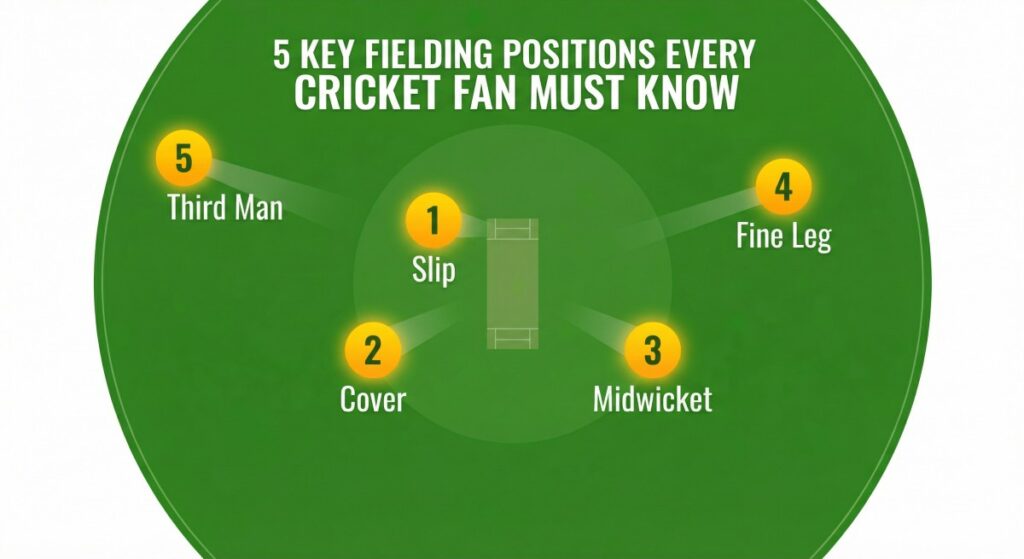
5 Cricket Field Positions Every Fan Must Know
If 30+ positions feel overwhelming, start with these five. You’ll hear them in every single match:
| Position | Why It Matters | |
|---|---|---|
| 1 | Slip | Where most catches happen in Test cricket |
| 2 | Cover | The most classic fielding position — a great cover fielder changes the game |
| 3 | Midwicket | The busiest position in limited-overs cricket |
| 4 | Fine Leg | Always in play — edges, flicks, and top-edges constantly go here |
| 5 | Third Man | Quietly saves dozens of runs every innings from edges and dabs |
FAQ
How many fielders are on a cricket field?
There are always 11 fielders on the field, including the bowler and wicketkeeper. So the captain places 9 fielders in various positions.
What is the most dangerous fielding position?
Short leg is widely considered the most dangerous. The fielder stands just a few yards from the batter and can be hit by powerful shots. They wear a helmet, shin guards, and a box for protection.
What does “in the ring” mean?
It refers to the 30-yard inner circle marked on the field in limited-overs cricket. Fielders “in the ring” are inside this circle. Powerplay rules dictate how many must stay inside during different phases.
What is cow corner?
Cow corner is the informal name for the area between deep midwicket and long on. Legend has it the name exists because cows used to graze in that part of the ground — the area where no fielder traditionally stood. It’s where unorthodox slog shots usually land.
Can a fielder stand anywhere?
Almost. Fielders can stand anywhere with two restrictions — powerplay rules limit how many can be outside the 30-yard circle, and no fielder except the wicketkeeper can stand on the pitch or behind the keeper.
Why do field positions change during a match?
Captains adjust cricket field positions based on the batter’s strengths, bowler’s plan, match situation, pitch conditions, and format. Field setting is one of the most tactical aspects of cricket.
Conclusion
Cricket field positions might seem complicated at first, but once you understand the three zones — close catching, infield, and boundary — and the two halves — off side and leg side — everything falls into place.
The beauty of cricket lies in these details. Every fielder placed is a tactical decision. Understanding these positions transforms how you watch the game — suddenly you see not just what happened, but why the captain planned for it.
Next time you watch a match, pick one position and track it through the innings. Watch how the captain moves fielders like chess pieces, adapting to every batter, every bowler, every phase.
That’s the beauty of cricket. Every ball is a new puzzle. Every field setting tells a story.
Read Next: What is Deep Midwicket in Cricket? Fielding Position Explained