
🔎 Quick Match Answer
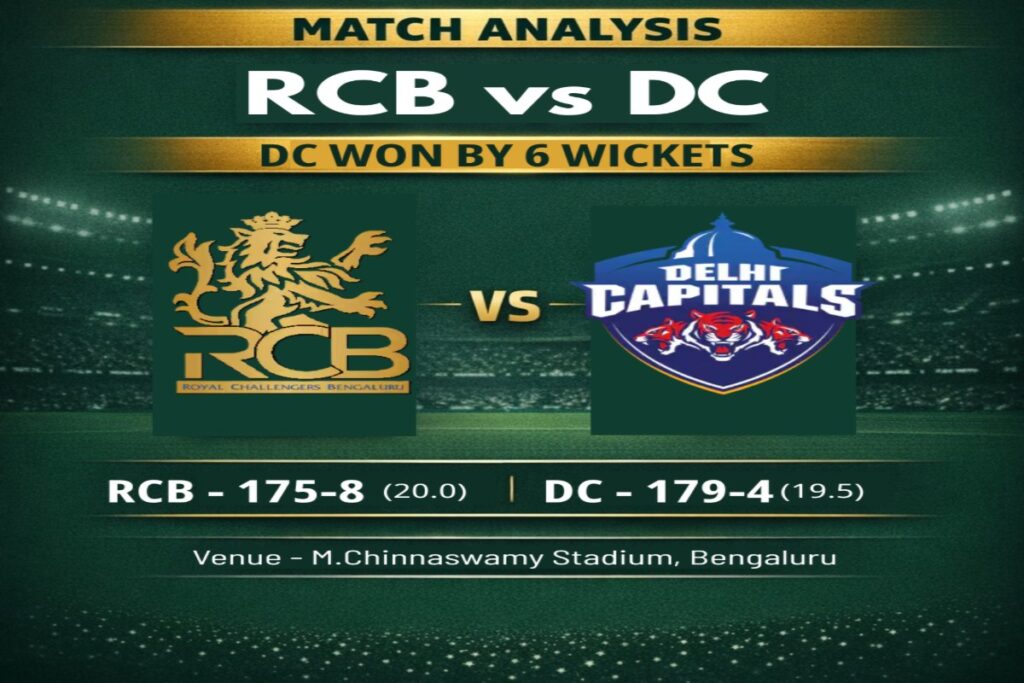
In this RCB vs DC match analysis, Delhi Capitals defeated Royal Challengers Bengaluru by 6 wickets, chasing 176 in 19.5 overs.
Thank you for reading this post, don't forget to subscribe!The game flipped in the middle overs where Axar Patel and Kuldeep Yadav strangled RCB, and in the death overs where DC finished calmly through KL Rahul and Tristan Stubbs.
📊 Match Snapshot
- RCB: 175/8 (20)
- DC: 179/4 (19.5)
- Result: DC won by 6 wickets
- Player of the Match: Tristan Stubbs
Key stat: RCB went from 99/1 (10 overs) to 175/8 — a collapse in scoring, not wickets.
🧪 Prediction vs Reality
This RCB vs DC match analysis exposes a flawed assumption — that 175 is defendable at Chinnaswamy.
Prediction: RCB advantage due to venue and batting depth.
Reality:
- Axar chose to bowl first on a dry pitch
- Spin dominated the middle phase
- DC chased with control despite 18/3
Conclusion: Conditions overruled reputation.
Read – 3 reasons why CSK will Lose the match
📈 Phase Dominance Report
⚡ Powerplay
- RCB: Strong start via Phil Salt (63 off 38 overall)
- DC: Collapse to 18/3, rescued by Rahul
RCB won this phase but failed to capitalize later.
🧩 Middle Overs
This is where the RCB vs DC match analysis turns decisive.
- Axar + Kuldeep: 4 wickets, zero momentum
- RCB lost intent, especially through slow middle order
- DC: Rahul + Stubbs stitched 69-run recovery
Insight: Spin didn’t just take wickets — it killed scoring rhythm.
💥 Death Overs
- RCB: Only 29 runs in last 5 overs
- DC: Clinical finish by Stubbs and David Miller
The final over from Romario Shepherd went for 17 — decisive.
🔥 Phase Verdict
DC dominated middle + death overs, which defines this RCB vs DC match analysis.
Spin created the deficit; poor death execution sealed it.
🔬 Why Team Won (3 key points)
1. Spin Control (Game-Changer)
Axar and Kuldeep turned a 200 pitch into a 175 total.
2. Rahul–Stubbs Stability
From 18/3 to control — not survival, but calculated chase-building.
3. Death Over Mismanagement
RCB gave the last over to an untested bowler. Miller capitalized instantly.
📉 Data That Matters
| Metric | RCB | DC |
|---|---|---|
| Total | 175/8 | 179/4 |
| 10 overs | 99/1 | — |
| Last 5 overs | 29 runs | — |
| Spin impact | Lost 4 wickets | Dominated |
| Key stand | — | Rahul–Stubbs (69) |
🎯 Turning Points
- Salt’s dismissal halted RCB momentum
- Rahul’s aggressive rebuild flipped pressure
- Miller’s final-over assault ended contest
🧠 Tactical Breakdown
Delhi Capitals:
- Bowled first on a dry pitch — correct read
- Used spin early and aggressively
- Held finishers back for control
Royal Challengers Bengaluru:
- Failed to adapt to slowing surface
- No spin counter-strategy
- Questionable death bowling decision
Key Insight:
At Chinnaswamy, reading pitch > stacking batting.
🧾 Player Impact Ratings
| Player | Role | Rating | Impact |
|---|---|---|---|
| Tristan Stubbs | Finisher | 9/10 | 60* anchored and finished |
| KL Rahul | Top order | 9/10 | 57 rescued chase |
| Phil Salt | Opener | 8/10 | Set strong base |
| Axar Patel | All-rounder | 8/10 | Controlled middle overs |
| Kuldeep Yadav | Spinner | 7.5/10 | Broke momentum |
| Romario Shepherd | Bowler | 3/10 | Lost match in final over |
🧭 What This Means
RCB:
- Vulnerable vs quality spin
- Death bowling lacks clarity
- Batting approach too one-dimensional
DC:
- Strong away template established
- Balanced attack + composed chase
- Emerging as playoff contender
🔁 What to Watch Next
- Can DC dominate on flat pitches without spin help?
- Will RCB restructure death bowling roles?
- Does RCB add a spin-resistant batter in middle order?
🧪 Prediction Tracker
- Prediction: RCB ❌
- Result: DC win
- Record: 17/26
Failure reason: Overestimated RCB’s finishing ability.
❓ FAQs
Who won RCB vs DC match?
Delhi Capitals won by 6 wickets.
What was the key moment?
Axar–Kuldeep middle overs choke.
Why did RCB lose?
Poor finish with bat + wrong death bowling call.
What’s the takeaway?
175 is below par on dry Chinnaswamy tracks.
🔥 Final Verdict
This RCB vs DC match analysis proves that matches are won in transitions, not highlights.
RCB dominated early but failed to adapt.
DC absorbed pressure, controlled the middle, and finished smart.
That’s not luck — that’s structure.