
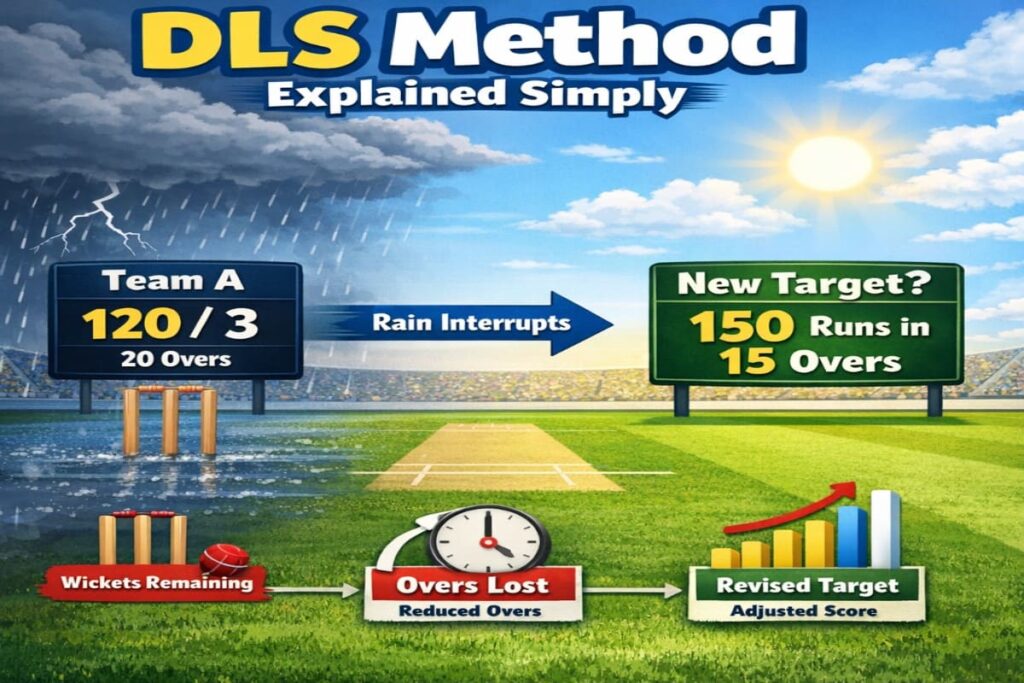
Rain stops play. The ground staff rush in with covers. Fans stare at the sky. And commentators start saying those three letters — DLS.
The DLS method (Duckworth-Lewis-Stern) is a mathematical formula used in cricket to calculate revised targets in rain-affected limited-overs matches. It considers two key resources — overs remaining and wickets in hand — to set a fair target for the chasing team when play is interrupted by weather.
If you’ve ever watched a rain-affected ODI or T20 match and wondered how on earth the revised target was calculated, you’re not alone. The DLS method in cricket confuses almost everyone the first time they encounter it. Most fans just accept the new target and move on without understanding the logic behind it.
Let’s change that. Here’s the DLS method explained in the simplest way possible — no maths degree required.
Why Does the DLS Method Exist?
Imagine this scenario:
Team A bats first – scores 280/4 in 50 overs.
Rain arrives – 10 overs are lost.
Team B now has only 40 overs to bat.
What should Team B’s target be?
Option 1: Keep the same target (280)
Unfair to Team B. They lost 10 overs but still need the same runs.
Option 2: Reduce the target proportionally (280 × 40/50 = 224)
Sounds fair, right? But it’s actually unfair to Team A. Here’s why — Team B still has 10 wickets in hand but needs fewer runs. They can bat more aggressively knowing they have overs to spare relative to the target. The batting team actually gets an advantage.
Option 3: Use a system that accounts for BOTH overs AND wickets.
That’s the DLS method.
What is the DLS Method?
The DLS method in cricket stands for Duckworth-Lewis-Stern — named after the three statisticians who developed and refined it:
- Frank Duckworth — co-creator (1997)
- Tony Lewis — co-creator (1997)
- Steven Stern — took over and updated it (2014 onwards)
It was first used internationally in 1997 and became the official ICC method for recalculating targets in rain-interrupted limited-overs matches (ODIs and T20Is).
Before DLS, cricket used simpler methods that were widely criticized for producing unfair results. The most infamous example being the 1992 World Cup semi-final between England and South Africa — but more on that later.
So how does the DLS method in cricket actually calculate these revised targets? Let’s break it down.
How Does the DLS Method Work?
Here’s the core concept simplified:
The Two Resources
The DLS method is built on one fundamental idea — a batting team has two resources to score runs:
RESOURCE 1: Overs remaining
RESOURCE 2: Wickets in hand
At the start of an innings, a team has 100% of its resources — all overs available and all 10 wickets in hand.
As the innings progresses:
- Overs get used up → resources decrease
- Wickets fall → resources decrease even faster
A team that is 50/0 in 10 overs has used some overs but has all wickets — they still have a LOT of resources left.
A team that is 50/5 in 10 overs has the same overs left but only 5 wickets — their resources have dropped significantly because fewer wickets means less ability to score freely.
The Key Insight
Wickets in hand matter just as much as overs remaining.
A team with 20 overs left and 8 wickets can score far more than a team with 20 overs left and 3 wickets. The DLS method accounts for this through a complex mathematical table that assigns a resource percentage to every possible combination of overs and wickets.
How the Target is Revised
- Step 1: Calculate TEAM A’s resources used (based on overs they batted and wickets lost)
- Step 2: Calculate TEAM B’s resources available (based on overs they’ll get after rain)
- Step 3: If Team B has FEWER resources than Team A, the target is reduced proportionally. If Team B has MORE resources than Team A (rare, but possible), the target is increased.
- Step 4: The revised target is announced.
That’s it. The concept is simple. The maths behind it is complex — but as fans, we don’t need to know the maths. We need to understand the logic.
A Simple Example
ODI Match:

Team A scores 250/8 in 50 overs.
Rain interrupts.
Team B gets only 40 overs to bat.

SIMPLE PROPORTIONAL METHOD:
  250 × (40/50) = 200
  Target: 200

DLS METHOD:
  Team A used X% of resources in 50 overs (10 wickets used/available)
  Team B has Y% of resources in 40 overs (10 wickets available)

  Since Team B still has all 10 wickets but fewer overs,
  their resource % is calculated differently.

  DLS target might be: 210 or 215
  (higher than simple proportional because Team B
  has all wickets — an advantage)
The DLS method essentially says — “You have fewer overs, but you have all your wickets. You can bat more aggressively. So your target is slightly higher than a simple proportion.”
To truly understand how the DLS method in cricket works in practice, let’s look at real match examples.
Real Match Examples
Example 1 — IPL 2024: CSK vs LSG
LSG batted first: 210/4 in 20 overs
Rain interruption
CSK got 17 overs to chase

DLS revised target: 175 in 17 overs

WHY NOT simply 210 × (17/20) = 178.5?
Because DLS considers CSK still has all 10 wickets
and the scoring rate typically increases in shorter
innings. The calculation adjusts for the actual
resource balance between both teams.
Example 2 — The Match That Changed Everything
1992 World Cup Semi-Final: England vs South Africa
England scored 252/6 in 45 overs (rain-reduced match)
South Africa were chasing well: 231/6 in 42.5 overs
Needed 22 off 13 balls — very gettable.

Rain stopped play for 12 minutes.
2 overs were lost.

Under the old "most productive overs" method:
  → The target was recalculated
  → South Africa now needed 22 off 1 ball
  → Yes. 22 off 1 ball. Impossible.

The scoreboard read: "22 runs needed off 1 ball"

South Africa were knocked out by a mathematical
absurdity. The cricketing world was outraged.

THIS is why the DLS method was created — to ensure
rain-affected results are FAIR.
When is DLS NOT Used?
❌ Test cricket — No limited overs, no DLS
❌ If both innings are completed — No interruption, no DLS
❌ If the match hasn’t started — Match abandoned, no DLS
❌ If minimum overs aren’t bowled — Match may be declared “No Result” instead
Minimum Overs Required for a Result
| Format | Minimum Overs for DLS Result |
|---|---|
| ODI | 20 overs per side |
| T20 | 5 overs per side |
If rain reduces the match below these minimums, the match is declared “No Result” and DLS isn’t applied.
DLS Method: Common Myths Busted
“DLS always favours the team batting second”
NOT TRUE. DLS can increase OR decrease the target. If the team batting second loses wickets before the rain interruption, their resource % drops. The revised target might actually be HARDER
relative to their position.
DLS is neutral. It favours neither team.
“DLS is unfair”
No system is perfect. But DLS is the MOST FAIR system ever created for rain-affected cricket.
Compare it to what came before:
→ Average run rate method (deeply flawed)
→ Most productive overs method (1992 disaster)
DLS isn’t perfect, but it’s the best solution available — and the ICC, players, and statisticians all agree on that.
“DLS is too complicated to understand”
The CALCULATION is complicated. The CONCEPT is simple: “How many runs should Team B chase, given they have fewer overs but potentially more wickets than Team A had at the same stage?” That’s it. That’s the entire concept.
Par Score — The Number You See on Screen
During rain-threatened matches, broadcasters show a “Par Score (DLS)” on screen.
This tells you:

"If rain stops play RIGHT NOW, the team
batting second needs to be at or above
this score to win."

Example:
  Par Score (DLS): 142
  Team B's current score: 148/3 in 25 overs

  If rain ends the match NOW → Team B wins
  (because they're above par)

  If Team B was 138/3 → Team B loses
  (because they're below par)
This is why you’ll often see teams accelerate when rain is approaching — they want to get above the DLS par score in case play doesn’t resume.
FAQ
Who invented the DLS method?
The DLS method in cricket was created by Frank Duckworth and Tony Lewis in 1997. Steven Stern updated and refined it in 2014, and it was renamed to the Duckworth-Lewis-Stern (DLS) method.
Is DLS used in IPL?
Yes. The DLS method in cricket is used in all ICC-sanctioned limited-overs matches, including the IPL, T20 World Cup, ODI World Cup, and bilateral series.
Can DLS increase the target?
Yes. If the team batting second has MORE resources than the team batting first (for example, if rain interrupted the first innings but not the second), the target can actually be increased above what the first team scored.
What happens if both innings are interrupted?
DLS handles multiple interruptions in both innings. The formula recalculates resources at each interruption point. This is where the method gets complex, but the principle stays the same — balance resources fairly.
Is there a DLS calculator?
Yes, several online DLS calculators exist. However, the official ICC version used in matches is proprietary and more detailed than public versions. The on-field calculation is done by match officials using ICC-approved software.
Conclusion
The DLS method in cricket exists for one reason — fairness. Rain doesn’t care about cricket, but cricket has to care about giving both teams a fair shot. Before DLS, rain-affected results were often absurd and unjust. Since 1997, DLS has ensured that when the weather intervenes, the maths gives both teams an honest chance.
Is it perfect? No. Is it complicated? The formula is. But the concept isn’t.
Two resources. Overs and wickets. Balance them fairly. Set a revised target.
That’s DLS. Simple, when you strip away the noise.
Next time rain stops play and a revised target flashes on screen, you’ll know exactly what’s happening — and you’ll be the one explaining it to everyone else in the room.
Read Next: Cricket Field Positions Explained – Complete Guide