
If you’ve been watching a cricket match, especially a T20 or ODI, you’ve probably heard the commentator say,
“There’s a fielder stationed at deep midwicket…”
But what exactly is deep midwicket in cricket? Where does this fielder stand? And why is it one of the most strategically important positions in modern-day cricket? Let’s break it down
Where is Deep Midwicket on the Field?
Deep midwicket in cricket is a boundary fielding positioned between the midwicket and mid-on regions, but much deeper — typically standing 10-15 meters inside the boundary rope or right on the edge of it.
to understand Deep midwicket in cricket imagine the cricket field as a clock with the Right hand batsman at the center facing down the bowler from 6 o’clock:
- Mid-on is at roughly 5 o’clock inside the 30 yards circle
- Midwicket is at about 4 o’clock at the edge of the 30 yard circle
- Deep midwicket sits at 4 o’clock but near the boundary
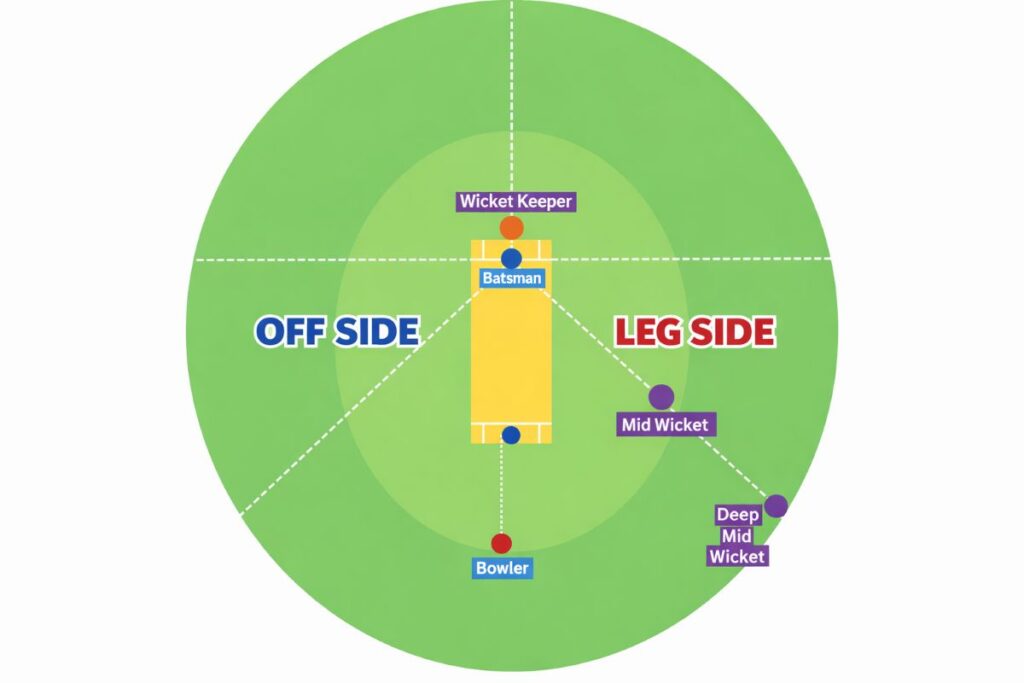
Deep Midwicket vs Midwicket
The confusion is common. The difference is simply depth.
| Midwicket | Deep Midwicket | |
| Where | Inside the 30-yard circle | Near the boundary |
| Primary job | Stop singles and twos | Prevent boundaries |
| Used most in | All Phases | Middle and death overs |
| Catches | Sharp, flat catches | High, skied catches |
When a captain pushes the midwicket fielder back to the rope, that fielder becomes the deep midwicket fielder. Same zone, different depth.
When Do Captains Use Deep Midwicket?
This position isn’t placed randomly. It’s a tactical decision that typically appears in these situations:
- Death overs in T20s/ODIs — Batsmen look to slog towards the leg side. Deep midwicket cuts off those boundaries and takes catches from mistimed heaves.
- Against set power-hitters — When someone like Rohit Sharma or Suryakumar Yadav is targeting the leg side with pulls and flicks, this fielder becomes a safety net.
- Short-ball strategy — Fast bowlers bowling bouncers expect pull shots. Deep midwicket works with deep square leg as part of the short-ball trap.
- When spinners are bowling — Batters love to slog-sweep spinners over midwicket. A deep fielder there forces them to either find the gap perfectly or risk getting caught.
Now you know what Deep Midwicket in cricket means and why captains rely on it.
Shots That Travel to Deep Midwicket
| Shot | Description |
| Pull Shot | Cross-batted hit off short-pitched bowling |
| Slog sweep | Powerful sweep lofted over the leg side |
| Midwicket heave | A full-blooded slog targeting the midwicket region |
| Flick over midwicket | Wristy flick off the pads, lofted over the infield |
| Helicopter shot | MS Dhoni’s signature — a wrist-driven shot soaring over the leg side |
A slight mistime on any of these, and the ball goes straight to the deep midwicket fielder rather than clearing the boundary. That’s what makes the position so valuable.
Deep Midwicket Across Formats
- Test Cricket — Rarely used. It’s considered too defensive unless a batter is aggressively targeting the leg side or a short-ball plan is in play.
- ODIs — Becomes important during middle overs (25–40) and death overs (45–50) as batters accelerate.
- T20s (IPL, BBL, T20Is) — This is where deep midwicket lives. It’s practically a permanent fixture from the 15th over onwards in most T20 innings.
Beyond the Boundary: Why This Blog is called The Deep Midwicket
Deep midwicket isn’t glamorous. It’s not the slip fielder in the action or the bowler in celebration.
It’s a quiet position at the boundary—out of focus, until suddenly everything depends on it.
That’s what makes it meaningful.
A lot of work happens there. Unseen. Patient. Prepared. It often feels like nothing will come your way.
But when it does, it matters.
The players who are ready—who’ve stayed sharp without the spotlight—make the difference. They take the catch. They save the boundary. They shift the game. That’s the idea behind The Deep Midwicket.
This is a space for going deeper into cricket—the insights, patterns, and stories most people overlook. Thoughtful, well-placed analysis from the edge, not the noise.
Because in cricket, as in life, the ones standing at the boundary — silent, watchful, ready — often make the most important play of the game.
Welcome to The Deep Midwicket!
Next Read: Cricket Field Positions Explained – The Complete Visual Guide